
8 Core Marketing · Insights
AI Overviews & Zero-Click Search: How to Stay Visible in 2026
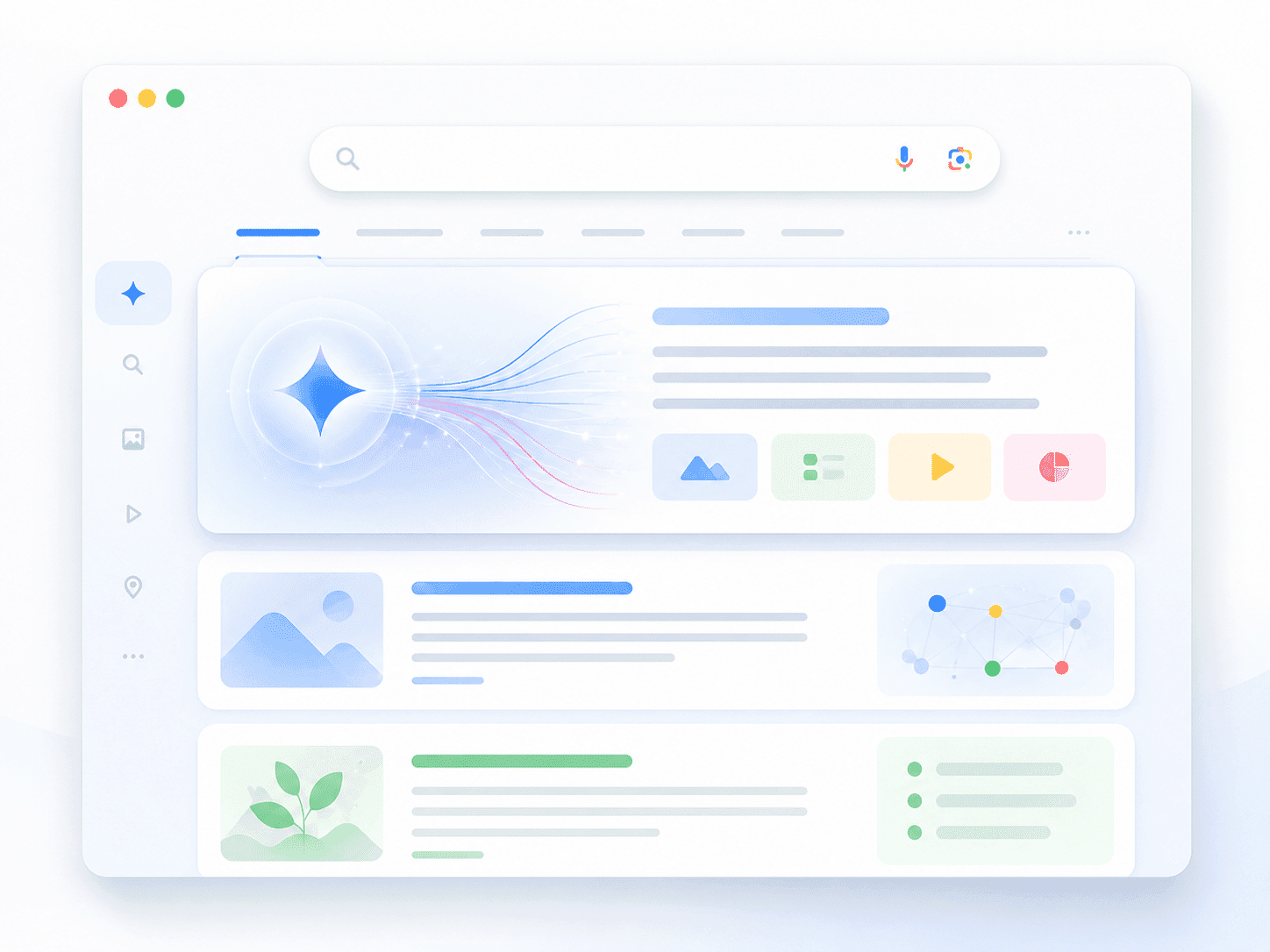
Imagine this: a potential customer searches for exactly what your business offers. Your page ranks on the first page of Google. But they never visit your site. They never even see your listing. Google has already answered their question — right there at the top of the results page — using an AI-generated summary pulled from multiple sources.
This isn't a future scenario. It's happening right now, on the majority of Google searches in 2026. Welcome to the era of AI Overviews and zero-click search — and if your digital strategy hasn't adapted, you're leaving visibility (and revenue) on the table.
In this guide, we'll break down what's actually happening with search, share the latest data, and give you nine actionable strategies to maintain and grow your visibility even when Google answers the question before anyone clicks. Whether you're managing SEO in-house or working with an agency, this is the playbook you need right now.
What Is Zero-Click Search?
A zero-click search is exactly what it sounds like — a search query that gets resolved directly on the Google results page without the user clicking through to any external website. The user types their question, Google provides the answer, and the tab gets closed. No click. No visit. No traffic to your site.
This happens through several SERP (Search Engine Results Page) features that have evolved over the past decade: featured snippets that pull a paragraph or list from a webpage, knowledge panels that display structured information about entities, People Also Ask boxes that expand into additional answers, local packs that show map results and business information, and the newest and most impactful of them all — AI Overviews.
The concept was first rigorously studied by Rand Fishkin and SparkToro using clickstream data around 2019, when roughly half of Google searches ended without a click. Since then, the trend has accelerated sharply — and the arrival of AI-generated answers has pushed it to a level that demands a fundamental shift in how businesses think about digital marketing.
What Are Google AI Overviews?
Google AI Overviews (previously called the Search Generative Experience, or SGE) are AI-generated summaries that appear at the very top of search results for many queries. Instead of presenting a list of links and letting users decide which to visit, Google's AI reads multiple web pages, synthesises the best information, and delivers a direct, paragraph-form answer — often with small citation links at the bottom.
Here's the critical distinction from older features like featured snippets: a featured snippet was extracted from a single source, providing that one URL with prominent visibility. An AI Overview is synthesised across multiple sources. It produces a single coherent paragraph that no individual website actually wrote. The citations are footnotes, not featured placements — and the click-through rate on those citations is dramatically lower than what featured snippets used to deliver.
AI Overviews now appear on approximately 50–60% of US search queries, up from just 6.49% in January 2025. Queries with eight or more words are 7x more likely to trigger an AI Overview. Google CEO Sundar Pichai has confirmed AI Overviews reach 2 billion monthly users across 200+ countries — making it the fastest-adopted feature in Google's history.
For businesses, this means Google is no longer just a directory of links — it's actively becoming a destination that resolves queries on its own. And that changes everything about how SEO strategy needs to work.
The 2026 Data You Can't Ignore
Let's put real numbers behind this shift. The following data comes from multiple independent studies published between late 2025 and early 2026, including research from SparkToro, Semrush, BrightEdge, Similarweb, Ahrefs, and Seer Interactive:
| Metric | Stat | Implication |
|---|---|---|
| Overall zero-click rate | ~58–65% of all Google searches | Less than 4 in 10 searches produce a click to any website |
| Zero-click rate with AI Overviews | ~83% | When AIO appears, only ~17% of users click through |
| Zero-click rate without AI Overviews | ~60% | Even traditional SERPs lose majority of clicks |
| Organic CTR drop with AIO | ~61% average decline | Position #1 no longer guarantees meaningful traffic |
| Mobile vs. desktop gap | ~27 percentage points higher on mobile | Mobile users are far more zero-click oriented |
| AI Overview queries in US | 50–60% of searches | This is mainstream, not experimental |
| AI Mode zero-click rate | ~93% | Google's conversational AI search is even more zero-click |
While AI Overviews reduce total click volume, the clicks that survive are significantly higher quality. Research shows these visitors have already read a summary and are seeking deeper information — making them higher-intent visitors who convert at better rates. One study found AI Overview traffic converts at 14.2% versus traditional organic traffic at 2.8%. The game has shifted from volume to value.
Why This Matters for Your Business
If you're running a business and relying on organic search traffic, these numbers aren't abstract — they directly affect your bottom line. Here's what this shift means in practical terms.
Your Rankings Don't Mean What They Used To
Ranking #1 used to mean you got the lion's share of clicks. In 2026, ranking #1 on a query that triggers an AI Overview might mean very few people ever see your listing, let alone click it. Multiple layers of features — AI summaries, People Also Ask, video carousels, image packs — now stack above the first traditional organic link. By the time a user scrolls to your result, their question has often been answered three times over.
Traffic-Only Metrics Are Incomplete
If your marketing reports only track organic sessions and click-through rates, they're capturing less than half the picture. A brand can have enormous search visibility — being cited in AI Overviews, appearing in knowledge panels, dominating People Also Ask — while showing flat or declining traffic numbers. This isn't failure; it's a measurement gap that your marketing strategy needs to account for.
Brand Visibility Is the New Currency
When your content is referenced in an AI-generated summary, your brand is being read, trusted, and associated with expertise — even without a click. This brand exposure has real value: it builds recognition, shapes purchase decisions, and drives branded search queries that do result in clicks and conversions.
The question is no longer "How do I rank #1?" — it's "How do I ensure my brand is visible, cited, and trusted across every surface where my audience searches?" That's a broader and more sophisticated challenge, but it's also an opportunity for businesses that adapt early.
Which Queries Are Most Affected?
Not all searches are equal in the zero-click era. Understanding which query types are most affected helps you prioritise where to focus your efforts — and where clicks are still very much on the table.
| Query Type | Zero-Click Impact | Strategy |
|---|---|---|
| Informational "What is content marketing" |
🔴 Very High — AI Overviews appear most frequently | Optimise for citation inside AI Overviews; build brand visibility |
| How-to / Educational "How to improve page speed" |
🔴 High — AIO synthesises step-by-step answers | Structure content in extractable, self-contained sections |
| Comparison "SEO vs PPC for small business" |
🟡 Medium-High — AIO provides summary comparisons | Create structured comparison content with clear data points |
| Commercial "Best SEO agency for ecommerce" |
🟡 Medium — Users still want to evaluate options | Focus on reviews, case studies, and differentiated positioning |
| Transactional "Hire a digital marketing agency" |
🟢 Lower — Users need to visit sites to take action | Optimise landing pages for conversion; maintain rank |
| Local "Marketing agency near me" |
🟢 Lower — AI Overviews appear in only ~7% of local searches | Invest in Google Business Profile and local SEO |
The pattern is clear: the further a query is from a purchase decision, the more likely it is to be fully resolved by AI on the results page. But informational content still matters — it's how you build the topical authority that gets your brand cited and trusted. The key is balancing your content mix across all intent types, which is where a strong SEO strategy makes all the difference.
9 Strategies to Stay Visible in the Zero-Click Era
Adapting to AI Overviews isn't about abandoning SEO — it's about evolving it. Here are nine strategies that work in 2026's search landscape, drawn from the latest research and what we're seeing produce results for clients at 8 Core Marketing.
Write for Citation, Not Just Rankings
The new SEO goal isn't just to rank — it's to get cited inside AI-generated answers. This requires a structural shift in how you write content. Start every section with a clear, self-contained answer paragraph of 134–167 words that can stand alone. AI systems extract these "semantic units" and weave them into overviews. If your opening paragraph sets up context before delivering the answer, you're making it harder for AI to cite you — regardless of how well you rank.
Research from 2026 shows that 44% of all AI citations come from the first 30% of a page's text. Lead with the answer. Always.
Implement Structured Data (Schema Markup)
Schema markup — typically implemented as JSON-LD — tells Google's AI exactly what your page contains. Whether it's an Article, FAQ, HowTo, Product, or Organisation page, structured data creates a bridge between your text and the knowledge graph. Studies show that pages with properly implemented schema markup see 73% higher selection rates in AI Overviews compared to unmarked content.
Start with FAQ and Article schema on your most important pages. If you're on WordPress, plugins like Yoast SEO or RankMath make this relatively straightforward. For businesses needing a more customised setup, our web development team can implement advanced schema across your site.
Build Topical Authority with Content Clusters
AI Overviews don't just evaluate individual pages — they assess how deeply your site covers a subject. Google favours pages that demonstrate breadth and depth across a topic rather than isolated pieces of content. The most effective approach is a topic cluster strategy: create a comprehensive pillar page around a core topic, then build supporting content that explores subtopics from multiple angles, all interlinked.
This reinforces your entity relationships (the associations between your brand, your experts, and your content topics), and the stronger those associations are, the more authoritative you appear to AI systems. If you're not sure how to structure this, a well-planned content marketing strategy is the foundation.
Prioritise E-E-A-T Signals
Experience, Expertise, Authoritativeness, and Trustworthiness (E-E-A-T) have always mattered for SEO, but they've become a critical filter for AI citation. Studies indicate that 96% of AI Overview citations come from sources with strong E-E-A-T signals. This means named authors with relevant credentials, original data and firsthand insights, strong backlink profiles, and mentions on respected industry sites.
Don't hide your team behind a generic "Admin" byline. Showcase real expertise. Link to author bios. Include original research, case studies, and data points that AI can't find anywhere else. This is what separates citeable content from commodity content.
Target Commercial and Transactional Keywords
While informational queries are heavily absorbed by AI Overviews, commercial and transactional searches still drive meaningful clicks. Users searching for "best email marketing platform for small business" or "hire an SEO agency" still need to visit websites to compare options, read reviews, and take action. These queries are where your traditional SEO investment continues to deliver direct ROI.
Audit your keyword portfolio. If you're over-indexed on informational content and under-invested in commercial intent pages — service pages, comparison guides, pricing content, landing pages — it's time to rebalance. This is especially true for service-based businesses where conversion-ready pages matter most.
Refresh and Update Content Regularly
AI systems assess freshness signals like publication dates, URL timestamps, and when a page was last updated. Content published in 2023 that hasn't been touched since is significantly less likely to be cited in 2026's AI Overviews. The recommendation across multiple studies is to refresh your top-performing pages every 3–6 months with updated statistics, new examples, current case studies, and fresh insights.
Updating existing high-authority pages is often more effective than publishing new content from scratch. Your best pages have accumulated backlinks and topical authority over time — refreshing them compounds that value rather than starting from zero.
Use Multi-Modal Content (Text + Images + Video)
Pages that combine text with images, video, and structured data see significantly higher selection rates in AI Overviews. This isn't about decorating your pages — it's about providing multiple formats through which AI can understand and extract your information. Infographics, original diagrams, embedded videos, and data visualisations all contribute to making your content more citable.
The modern SERP is a modular environment with multiple entry points: image packs, video carousels, AI summaries, and traditional links. Each format is a visibility opportunity. A single piece of content that includes an optimised image, a video embed, structured FAQ, and well-formatted text gives you a presence across multiple SERP features from one page.
Optimise for Featured Snippets
There's a strong correlation between content that earns featured snippets and content that gets pulled into AI Overviews. Google's AI regularly cites content already optimised for snippet formats — definitions, numbered lists, comparison tables, and direct answers. If you're winning featured snippets, you're well-positioned for AI citation too.
Format your content with clear H2/H3 headings that mirror how people ask questions, followed by concise, direct answers in the first paragraph of each section. Tables, numbered steps, and bulleted lists formatted with proper HTML help AI systems parse your content more accurately.
Build Owned Audience Channels
The most resilient strategy in the zero-click era? Don't rely solely on Google for discovery. Build direct relationships with your audience through email lists, social media communities, podcasts, and owned platforms. These channels bypass search entirely and give you a direct line to people who already know and trust your brand.
When someone subscribes to your email list or follows your brand on social media, you no longer need Google to broker that relationship. This doesn't mean abandoning search — it means building a diversified acquisition strategy where search is one powerful channel among several. Combine this with a strong digital marketing mix and you're insulated against platform changes.
Brands that establish citation authority now gain compounding advantages. Once AI systems select a trusted source, they tend to reinforce that choice across related queries. Your competitor who builds comprehensive, well-structured content today becomes the default citation in your category tomorrow. The window to build this advantage is open right now — don't wait.
New Metrics for the New Era
If your reporting is still built entirely around organic sessions and CTR, you're measuring the scoreboard of a different game. The zero-click era demands a new measurement framework that captures the full picture of your search visibility. Here's what to track:
SERP Visibility & Feature Share
Monitor how often your brand appears across all SERP features — AI Overviews, featured snippets, People Also Ask, knowledge panels, local packs — not just organic rankings. Tools like Semrush's AI Toolkit and Ahrefs' AI Visibility feature are developing tracking for this in 2026.
AI Citation Frequency
Manually search your target keywords and note whether your site appears as a citation in AI Overviews. Track this weekly or monthly alongside traditional rank tracking. The brands that show up in AI citations consistently are building compounding authority.
Branded Search Volume
When people see your brand in AI summaries, some of them will search for your brand directly. Growth in branded search queries is a strong signal that your zero-click visibility is translating into actual awareness and intent.
Conversion Quality (Not Just Volume)
Since the visitors who do click through from AI Overviews tend to be higher-intent, your conversion rates may improve even as total traffic decreases. Track revenue per session and conversion rate alongside volume metrics. Value-based reporting matters more than volume-based reporting in this era.
Cross-Platform Visibility
Google isn't the only discovery surface anymore. Track whether your content is cited by ChatGPT, Perplexity, Microsoft Copilot, and other AI search platforms. Only 12% of URLs cited by these platforms match Google's top 10 results — meaning AI search has its own visibility landscape that's worth monitoring.
Beyond Google: AI Search Is Everywhere
Google AI Overviews are the biggest story, but they're not the whole story. The zero-click phenomenon extends across a growing ecosystem of AI-powered search and discovery platforms that are all eating into traditional website traffic.
ChatGPT Search is powered by Bing's index and generates conversational answers with citations. Its zero-click rate is even higher than Google's. Perplexity AI is built as an answer engine from the ground up — direct answers with source citations, minimal click-through by design. Microsoft Copilot integrates AI search across Bing, Windows, and Microsoft 365, creating AI-mediated discovery across the tools millions of professionals use daily. And Google's AI Mode — the fully conversational search experience — shows a staggering ~93% zero-click rate in early data.
The strategic implication: optimising for one platform isn't enough. Your content needs to be structured, authoritative, and extractable across all of them. The good news is that the fundamentals — clear structure, strong E-E-A-T, schema markup, topical depth — work across every AI discovery surface. Strong traditional SEO remains the foundation that all AI systems draw from.
We're in the early stages of a permanent shift from search engines that show links to answer engines that resolve queries. This isn't going to reverse. The brands that thrive will be those that embrace visibility-first strategies, build genuine authority, and optimise for the full ecosystem of AI-driven discovery platforms — not just Google. This is the most significant transformation in search marketing history, and the winners are being decided right now.
Frequently Asked Questions
What is a zero-click search?
A zero-click search occurs when a user's query is answered directly on the search engine results page without the user clicking through to any external website. This happens through AI Overviews, featured snippets, knowledge panels, People Also Ask boxes, and local packs. As of 2026, roughly 60% of all Google searches end this way.
What are Google AI Overviews?
Google AI Overviews are AI-generated summaries that appear at the very top of search results. Google's AI reads multiple web pages, synthesises the best information, and presents it as a direct answer — often eliminating the need for users to visit individual websites. They now appear on over 50% of US search queries.
How much do AI Overviews reduce organic click-through rates?
Studies from late 2025 and early 2026 indicate that organic click-through rates drop by approximately 61% on average for queries where AI Overviews appear. However, the clicks that do come through tend to be from higher-intent visitors who convert at significantly better rates — in some studies, 5x higher conversion rates than traditional organic traffic.
Is SEO dead because of zero-click search?
No — but it has evolved. Traditional SEO focused purely on rankings and traffic is incomplete. Modern SEO in 2026 is about visibility across all SERP surfaces, including AI Overviews, featured snippets, and knowledge panels. The fundamentals — quality content, technical health, structured data, and authority — are more important than ever. They're just serving a broader goal than click-through alone.
How do I get my content cited in AI Overviews?
Focus on five key signals: write self-contained answer paragraphs of 134–167 words at the start of each section, implement schema markup (Article, FAQ, HowTo), build topical authority through interlinked content clusters, strengthen E-E-A-T signals with named authors and original data, and keep content fresh with quarterly updates. Pages with strong structure can earn citations even if they don't rank in the traditional top 10.
Can my business still get traffic from Google?
Absolutely. Commercial and transactional queries — where users need to compare options, evaluate services, or make purchases — still drive meaningful click-through. Local searches are also less affected, with AI Overviews appearing in only about 7% of local queries. The strategy is to target these high-value intent types for traffic while using informational content to build the authority and citations that fuel broader brand visibility.
How quickly can I see results from AI Overview optimisation?
Foundation work — implementing schema, restructuring content, establishing entity consistency — typically takes 4–8 weeks. Authority building through cross-platform presence and content depth takes 3–6 months. Most brands that implement systematic optimisation see measurable citation improvements within 90 days.
What Should You Do Next?
The shift to AI-powered search isn't coming — it's already here. And the businesses that adapt their SEO and content strategies now will have compounding advantages that late movers can't easily overcome.
Here's a starting checklist you can action this week:
First, audit your top 10 pages — do they start with clear, direct answers that AI can extract? Second, check your schema markup — are you using Article, FAQ, and HowTo schema on your most important content? Third, search your target keywords and note whether AI Overviews appear and who's being cited. Fourth, assess your content mix — are you balanced across informational, commercial, and transactional intent? And fifth, start tracking AI visibility alongside traditional rankings and traffic.
If that feels like a lot to tackle alone, you don't have to. Our team at 8 Core Marketing helps businesses navigate exactly this transition — from traditional SEO to AI-era visibility strategies that actually drive results.
Ready to Future-Proof Your SEO?
Get a free visibility audit and learn exactly where your brand stands in the AI search landscape — and what to do about it.
Schedule Your Free Consultation →